

 Platform Overview
 Unified Intelligence
 Customer Engagement
 Commerce and Fulfillment
 About Us
 Come Work with Us
 Newsroom
 Events
 Insights
 Blog
Blog
 Digital Grocer Podcast


What 1,001 Shoppers Just Told You About Your Grocery Business
Every year, Progressive Grocer surveys more than a thousand grocery shoppers to find out how they think, what they want, and where they’re shopping.
The 77th Consumer Expenditures Study landed last month.
It’s presented in a way that most grocers will read as market research. But it’s actually a checklist.
Several findings, each one describing a specific shift in how your customers are shopping right now: what’s driving their decisions, where their loyalty is going, and what would have to be true for more of it to come to you.
Some of those findings will confirm what you already suspect. Others may surprise you. But all of them point to the necessity of taking action.
In a market where Walmart and Amazon are raising the bar on personalization, speed, and value every quarter, the cost of not acting is no longer abstract.
Throughout this article, we’ll show how DXPro—Mercatus’s digital experience platform built specifically for grocery retail—gives you the tools to respond. Not in theory, but in practice, with specific capabilities mapped to each shift in shopper behavior.
Here are the six findings that matter most, and what you can do about it for your grocery business.
Finding 1: Price Sensitivity is Intensifying
We begin with pricing because everything else builds on it.
What the study found
Price has been top of mind for grocery shoppers for a while now, but this year’s study suggests it’s becoming more acute, not less.
Three in four shoppers have changed their buying behavior because of price. They’re buying fewer unplanned items, trading down to private labels, and actively hunting deals across banners.
When asked what they like most about the store they shop most often, 42% named price and value, ahead of product quality, store cleanliness, and speed of shop combined.
What this means for grocers
To respond to pricing concerns, the instinct for many grocers is to implement more promotions and discounts.
The problem is that blanket discounts train shoppers to wait for sales rather than shop on habit, and they mark down items that would have sold anyway. Each one slices into margins that are already thin.
More promotions don’t solve a price sensitivity problem. They reinforce it.
What actually moves the needle towards profitability and loyalty is relevance.
A shopper who receives an offer on the specific items they buy, timed to when they typically buy them, experiences that as genuine value. A shopper who gets the same email as everyone else just sees another promotion they didn’t ask for.
What you can do with DXPro
This is exactly the problem DXPro is built to solve.
Rather than giving you a broader set of blunt instruments, it gives you the ability to build personalized, data-driven offers targeted to individual households based on their actual purchase behavior.
For instance, DXPro can identify price-sensitive shoppers and prioritize serving them the latest deals available. This identified audience could be senta store offer for a discounts off their purchase or reduced fulfillment fees to encourage them to place an online order in the first place.
DXPro knows which of the items on sale that a customer will care about most and sends these specific discounts to them in priority rank instead of the same circular as someone whose cart looks nothing like theirs.
Think about what that looks like in practice.
A family that buys your store’s private label brand of coffee every two weeks gets an offer on that coffee before their next expected purchase, not a generic storewide discount they have to dig through. A shopper who regularly buys sale items in store gets a promotion for a free pickup order that saves them time on their next trip.

The result is a discount that works twice as hard: it gives price-conscious shoppers a concrete, personal reason to choose you over the competition, while protecting the margin that blanket promotions quietly drain away.
Over time, that relevance builds the kind of habit that keeps shoppers off a competitor’s app entirely.
Finding 2: Shoppers are Consolidating Trips
This finding is closely connected to the first, but the implication runs deeper.
What the study found
Shoppers aren’t just spending less. They’re spending more deliberately. That means fewer trips overall.
Compared to last year, more shoppers now identify as planners rather than impulse buyers, with a growing preference for stock-up trips over smaller, more frequent ones.
When budgets tighten, loyalty doesn’t disappear. It concentrates. Shoppers commit to the formats delivering the most value per trip and quietly stop visiting the ones that don’t.
What this means for grocers
We know this isn’t purely a price story because shoppers aren’t just consolidating to the cheapest option. They’re consolidating to the most reliable one.
We’ve seen recent growth in delivery and ship-to-home due to major initiatives from both Walmart and Amazon around increased convenience.
It’s a smart strategy because the store that consistently makes shoppers feel like their money goes further becomes the default. The store that doesn’t do that becomes optional, then occasional, then gone from the rotation entirely.
Regional grocers can’t out-price Walmart or out-ship Amazon. But they can out-personalize both.
What you can do with DXPro
DXPro gives you the tools to become the store that shoppers reorganize their week around rather than occasionally visit.
By delivering loyalty-driven pricing and targeted promotions that reflect what each household actually buys, value stops being a brand promise and becomes something a shopper feels on every receipt.
The proof is in the behavior it creates.
Mercatus research found that multi-channel shoppers average more than 60 in-store trips a year, while layering online orders on top. Their digital baskets averaged around $100, which is a little smaller than online-only customers at $115.
However, these additional in-store orders pushed their total annual spend well past their single-channel peers.
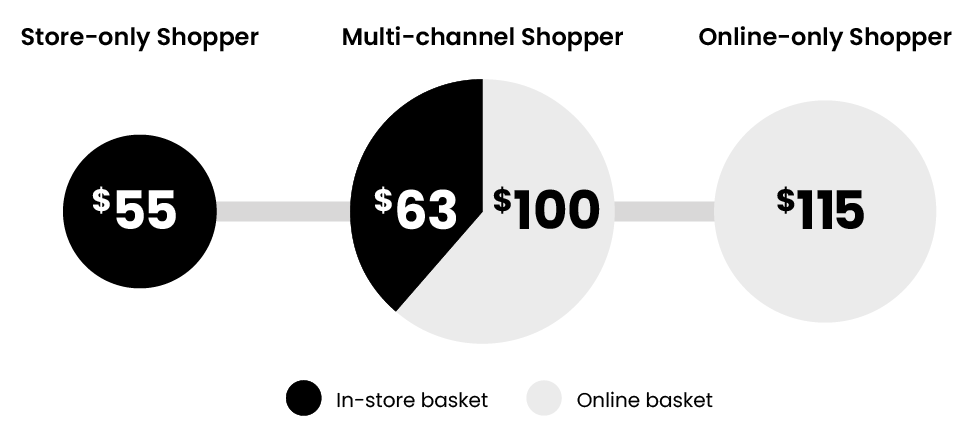
That’s not a shopper splitting their spending across formats.
That’s a shopper who found enough value in one banner to stop looking elsewhere. DXPro is what builds that kind of loyalty.
Finding 3: Loyalty Programs and Mobile Apps are Non-negotiable
If the first two findings are about price, this one is about the infrastructure behind it.
What the study found
Loyalty program participation is growing in a meaningful way.
Nearly two-thirds of shoppers are actively enrolled in and using a grocery loyalty program, up from 58% in the prior year. Half of all respondents actively use their grocery store’s mobile app. The most-used features are personalized coupons, rewards visibility, and digital grocery lists.
What this means for grocers
All of these point to the same thing: Shoppers are actively looking for reasons to engage, and they’re rewarding the stores that give them one.
A grocer without a capable loyalty program and mobile app isn’t missing a feature. They’re losing the customers most likely to become their most valuable ones to the banners that do.
What you can do with DXPro
DXPro gives you the full stack to deliver that experience—native iOS and Android apps, multi-channel messaging across email, SMS, push, and in-app, and automated engagement programs that trigger based on real shopper behavior rather than a campaign calendar.
The impact of keeping shoppers engaged is well documented.
Mercatus research found that shoppers who engage with a grocer’s digital platform four or more times a month take 2.5 times more trips and spend 2.6 times more per person than those who engage once a month or less.
Moving a shopper from occasional engagement to consistent engagement raised revenue per household from $639 to $1,547.
That’s not a marginal lift. That’s a different customer entirely and DXPro is what gets them there.
Finding 4: Online Satisfaction is Up—But Friction Remains
Loyalty programs and mobile apps bring shoppers in.
What keeps them there is an online shopping experience that doesn’t let them down at the moment it matters most.
What the study found
Eighty percent of shoppers now report high satisfaction with online grocery, a meaningful jump from prior years.
But the complaints that remain are consistent: high fees and out-of-stock experiences are the top reasons shoppers aren’t completely satisfied.
What this means for grocers
High fees are a marketplace problem.
Out-of-stock frustration is an order management problem.
Both are solvable, but only if you own the channel and the fulfillment infrastructure behind it. Renting the customer experience from a third party means inheriting their limitations and paying for the privilege.
What you can do with DXPro
DXPro removes both friction points directly, by giving you full ownership of the channel and the infrastructure to run it well.
Think about what that means for a shopper who has been burned before. They’ve placed an online order, paid a delivery fee, and had two items substituted without warning.
With DXPro, that same shopper places an order through your branded storefront, pays with their preferred method, and receives consolidated updates when their order has been picked and packed. They can approve or decline substitutions to ensure no surprises. It’s a clean, reliable experience that reflects your brand, not a third party’s. And it’s only made possible through a back-end experience that gives grocers real-time visibility into how orders move through the system—where pressure is building, when lead times need to adjust, and where staging is starting to stack up before a shopper ever feels it.

Capacity can be adjusted on the fly, bottlenecks flagged before they become problems, and fulfillment kept in sync with the labor actually available on the floor.
When operations run that cleanly, substitutions drop, handoffs feel effortless, and the experience a shopper gets matches the one they were promised.
Finding 5: Younger Shoppers Want Prepared Foods—Most Grocers Can’t Serve Them
The previous findings are largely about protecting what you have. This one is about capturing something you’re currently leaving on the table.
What the study found
The gap between what shoppers want and what they can actually get is a direct revenue gap.
Forty percent of prepared food buyers say they prefer made-to-order items, but grab-and-go accounts for 42% of actual purchases because it’s what’s available.
And the shoppers driving that unmet demand are younger: 50% of Gen Z and 37% of Millennials named lunch as their most recent prepared food occasion, compared to just 23% of Boomers.
What this means for grocers
When customers can’t find what they’re looking for at your store, they might choose something else one or two times. However, the moment they find it elsewhere, they’re gone.
Closing the gap mentioned above doesn’t just require having the service offering; it means having the infrastructure, too. Grocers need a way to let a shopper order lunch from their phone in the morning and pick it up without friction at noon.
What you can do with DXPro
DXPro includes native support for perimeter department ordering—deli, bakery, catering, and prepared meals—built to handle the operational complexity that generic eCommerce platforms ignore entirely. Grocers can even create a mini shop out of specific SKUs that can cater to specific customer segments.
Think about what that looks like for a Millennial on a Tuesday morning. They open your app at 9 a.m., place a made-to-order lunch for pickup at 12:30, and get a notification when it’s ready. They pull up, grab their order (plus a few staples they forgot to get in their last order), and they do it all in under 10 minutes on their lunch break.
No waiting. No uncertainty. No reason to stop at the convenience store on the way back from the office.

That’s the experience that turns a demographic shift in the data into a revenue line on your P&L. DXPro’s made-to-order scheduling, real-time fulfillment tracking, and customer-facing status updates are what make it operationally possible.
Finding 6: Most Shoppers Are Health-Conscious. Few Feel Like Their Store Knows It
Every finding so far has been about getting shoppers in, keeping them engaged, and serving them reliably.
This last one is about something harder to manufacture and more valuable once you have it: the feeling that a store genuinely understands you.
What the study found
Seventy-six percent of shoppers now consider themselves health-conscious, a significant jump from last year.
Nearly all are satisfied with their primary store’s health-related offerings. But satisfaction with what’s on the shelf and satisfaction with how a store serves your specific preferences are two different things—and the gap between them is where loyalty is won or lost.
What this means for grocers
Stocking the right products is table stakes. Every grocer in this study is already doing it. What separates the stores that build lasting loyalty from the ones that don’t is whether the shopping experience itself feels like it was built for that individual shopper—their preferences, their household, their habits—or for health-conscious shoppers as a generic demographic.
A shopper who has to search for what they care about feels like a customer. A shopper who sees it surface without asking feels like a regular.
What you can do with DXPro
DXPro builds a complete picture of every shopper from every interaction that happens on your platform—every click, every view, every purchase—so the experience you deliver reflects what each customer actually cares about, not what you assume they do.
In practice, that means a shopper who consistently buys high-protein snacks and organic dairy doesn’t hunt for what’s relevant to them. Their search results surface it. Their promotions reflect it. Their next visit starts exactly where their last one left off.
Over time, that shopper doesn’t just feel satisfied with your health offerings. They feel like your store gets them in a way that others don’t.
The proof that relevance drives results is concrete. When one retailer used DXPro to deliver targeted, personalized offers to at-risk shoppers, 65% returned within two weeks, 90% kept shopping for months afterward, and average basket size grew 40%.
That’s what happens when the right offer reaches the right shopper at the right moment—and it’s the same capability that makes every health-conscious shopper in your database feel individually understood rather than generically served.
What The Data Is Telling You
Six findings. One consistent message.
Shoppers are making more deliberate choices about where their money goes and what kind of experience earns their repeat business.
The retailers who will hold and grow their market share are the ones who can respond to individual behavior—not broad segments, not weekly themes, not instinct.
Accomplishing this requires a platform with the data, the engagement tools, and the commerce infrastructure to act on what each shopper is already telling you.
That’s what DXPro is built to do.
If you’ve read the Progressive Grocer study and you’re wondering whether your current tech stack can respond to what it’s describing, set up a time to talk to our team today. See how DXPro can turn today’s shopper behavior into a system for measurable growth for your grocery business.