


 Platform Overview
 Unified Intelligence
 Customer Engagement
 Commerce and Fulfillment
 Retail Media Network
 About Us
 Come Work with Us
 Newsroom
 Events
 Insights
 Blog
Blog
 Digital Grocer Podcast


Why Customer Lifetime Value Remains The Most Important Metric in Grocery Retail Today
This article was originally published on July 23, 2020. It was updated on July 18, 2026.
Short-term gains or long-term growth?
Businesses across every sector wrestle with these two goals, often pulling in opposite directions.
For grocers, one avenue for quick wins has traditionally come in the form of breakage: the quiet profits gained from unclaimed discounts, rewards, and promotions.
The reasoning is that when customers don’t redeem promotional offers, the grocer’s bottom line gets a hidden boost.
But as consumer expectations rise toward increased personalization and better overall service, breakage is proving to be a short-sighted strategy that fails to build sustainable growth.
Instead of transactions, grocers should be thinking in terms of relationships. That means turning to more holistic performance metrics, like Customer Lifetime Value.
Why Does Customer Lifetime Value (CLV) Matter?
As larger retailers like Walmart and Amazon continue to take a larger share of the grocery market, grocers are seeing how important customer retention is to the total revenue of their businesses.
But the threat isn’t just market share erosion. It’s a fundamental change in how customers shop.
How Modern Consumers Shop Today
The same customer who fills a cart at a regional grocer Saturday morning will open DoorDash Monday to order lunch ingredients, place a Walmart delivery order Tuesday for household basics, and return to the regional grocer’s app Friday for a weekend pickup order.
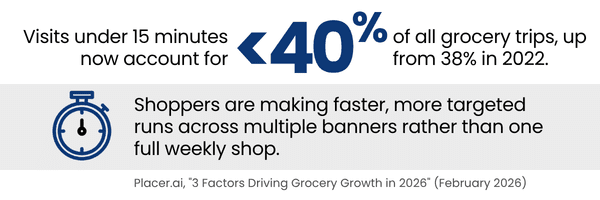
Today’s grocery shoppers are making moment-by-moment decisions about where to source different categories based on price, availability, and convenience factors that shift day to day.
When budgets tighten, that behavior doesn’t stop. It concentrates.
Shoppers commit to the stores delivering the most value per trip and quietly drop the ones that don’t. The store that consistently makes shoppers feel like their money goes further becomes the default. The store that doesn’t becomes optional, then occasional, then gone from the rotation entirely.
This is why Customer Lifetime Value has become the most important KPI for grocers.
It prompts strategies focused on long-term relationships with loyal customers rather than quick wins, and it forces grocers to reckon with the fact that every customer’s spending is actively being contested by competitors across every trip.
How To Calculate Customer Lifetime Value
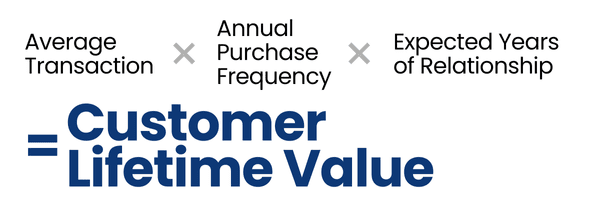
When you calculate Customer Lifetime Value, it’s important to accurately estimate your average customer lifespan, the typical duration a customer stays active with your business.
This can be done in three steps:
1. Define Inactive Status
Determine when a customer is considered inactive, such as after 12 months without a purchase.
2. Track Lifespan
Measure the time between each customer’s first and last purchases to determine their individual lifespan.
3. Calculate the Average
Add up these individual lifespans and divide by the total number of customers to get the average customer lifespan.
Factoring in Customer Acquisition Cost
Average order value, purchase frequency, and customer lifespan give you a baseline CLV, but pairing that number with customer acquisition cost shows whether the relationship is actually profitable.
If a grocer spends heavily to acquire a customer through paid promotions or discounting, a high CLV can still mask a thin margin.
Factoring in acquisition cost alongside retention rates gives a more complete view of which customer segments are genuinely driving profitability, not just volume.
How Grocers Can Benefit from Measuring Customer Lifetime Value
This is especially important in grocery retail because few businesses depend on repeat visits the way grocery does.
Customers shop weekly, sometimes more. The relationship can last years.
That’s what makes CLV so useful here: It gives grocers a way to measure whether those long relationships are actually getting more valuable over time or quietly eroding.
Customer Segmentation
Instead of treating every customer the same, you can see which shoppers are driving the most value and build around them: loyalty programs that reward the behaviors you want to see more of, promotions timed to individual purchase cycles, and engagement that reflects what each household actually buys.
The customers already shopping at your stores are cheaper to retain than new ones are to acquire, and CLV shows you exactly where that retention investment pays off the most.
Using Engagement to Boost Customer Lifetime Value
That doesn’t mean ignoring everyone else. It means spending smarter.
To retain high-value customers, grocers have to personalize the shopping experience at every stage, from a shopper’s first purchase through their most loyal, highest-frequency years.
Here’s how that works in practice.
Targeted Savings
When a grocer can see what individual customers actually search for and buy, promotions stop being generic and start being useful.
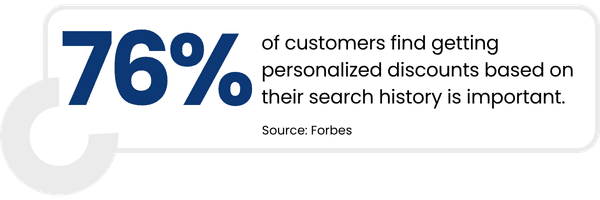
A customer who buys organic produce every week gets a discount on organic vegetables before their usual shopping trip. A household that stocks up on pantry staples monthly gets offers timed to that cycle.
The difference between a blanket coupon and a targeted offer is the difference between training customers to wait for sales and reinforcing the habit of shopping with you.
Customizable Customer Loyalty Programs
One-size-fits-all loyalty programs reward everyone the same way, which means they reward no one particularly well. Data-driven programs can do more.
High-frequency shoppers earn discounts tailored to their purchase history. Occasional shoppers receive incentives designed to bring them back sooner. The program stays relevant to each customer because it adapts to how they actually shop, rather than applying the same structure to a household spending $200 a week and one spending $50 a month.
Predictive Personalization
Personalization is where the pieces connect.
By analyzing purchase cycles and anticipating what a customer will need before they go looking for it, grocers can bring a highly relevant offer to a family that restocks chicken broth every few weeks or the person who buys their ground coffee at the same time every month.
Depending on their behavior, each customer can receive a curated shopping list or targeted discounts right when they’re due to shop again.
That timing matters. When an offer arrives at the moment a customer is already thinking about their next trip, it’s not an interruption. It’s a convenience. They’re more likely to add items, more likely to complete the order through your platform, and more likely to come back on the same cycle next time.
Over time, this compounds. Customers visit more often, spend more per order, and stay engaged longer.
That’s CLV moving in the right direction across every segment, not just the top tier.
Mercatus Offers the Technology Grocers Need to Boost Customer Lifetime Value
The personalization described above, from targeted savings to predictive, loyalty-driven experiences, is exactly what DXPro is built to deliver.
DXPro brings customer data, engagement tools, commerce capabilities, and fulfillment workflows together in one platform, so that every interaction you have with a customer creates intelligence that improves the next.
Customer Data
It starts with DXPro’s embedded customer data platform, which captures every on-platform interaction, every click, view, and purchase that happens within a grocer’s storefront, and turns that activity into unified customer profiles.
Those profiles make the targeted savings and dynamic loyalty programs described above possible through engagement driven by how individual customers actually shop.
Personalized Engagement
From there, DXPro’s engagement tools allow you to put the intelligence you’ve collected from customers into action.
Automated programs trigger personalized offers when a shopper’s purchase frequency declines or their basket composition shifts. Promotional targeting reflects browsing history whether customers order delivery or shop in-store. Loyalty rewards recognize valuable behaviors regardless of channel.
Streamlined Commerce
And DXPro’s commerce engine converts that engagement into transactions, then feeds transaction data back into customer profiles to strengthen future engagement.
Each purchase refines the system’s understanding of preferences and shopping patterns, making the next interaction more relevant. Better data drives better engagement, which drives more sales, which produces better data.
That cycle is what moves CLV upward across every customer segment.
Purpose-Built for Grocery
Every feature, from segmentation to promotions to fulfillment, is designed around how grocery shoppers actually buy.
DXPro isn’t a general retail template. It’s a platform tailored to how grocers operate and sell, with native support for complex promotions, flexible payment options including SNAP/EBT, and fulfillment orchestration that plugs into whatever providers a grocer already has in place.
Start With What You Need. Add What You Want
DXPro is also modular, allowing grocers to deploy what they need now and add capabilities as they grow without rebuilding their stack.
That matters for CLV specifically because personalization and loyalty programs only stay effective when grocers can keep iterating: testing new segments, adjusting offers, and responding to shifting shopping behavior without waiting on development cycles.
Turn Customer Lifetime Value Into Long-Term Growth
Every section of this article comes back to the same premise: the grocers who treat each customer interaction as an opportunity to earn the next one are the grocers who will grow in a market where Walmart and Amazon keep raising the bar.
CLV is the metric that tells you whether your engagement is actually deepening relationships or just generating activity. It tells you whether your most valuable customers are getting more valuable or starting to drift. And it gives you a baseline to measure against as you refine the personalization, loyalty, and fulfillment strategies that protect your revenue over time.
DXPro gives grocery businesses the unified platform to act on all of it: customer data that powers engagement, engagement that drives commerce, and commerce that feeds intelligence back into the system.
One connected cycle from one connected platform, purpose-built for grocery.
To see how Mercatus can help your business turn customer relationships into long-term growth, reach out to our sales team today.
