


 Platform Overview
 Unified Intelligence
 Customer Engagement
 Commerce and Fulfillment
 Retail Media Network
 About Us
 Come Work with Us
 Newsroom
 Events
 Insights
 Blog
Blog
 Digital Grocer Podcast
5 Digital Customer Engagement Strategies That Retain Shoppers in 2026
For years the only way onto a shopper’s kitchen table was through their mailbox.
Grocers printed one weekly flyer, sent it to every home within a 5 mile radius, and hoped that broad reach would put the right offer in front of enough people.
It wasn’t precise, but it was the best option available.
Today shoppers plan purchases on their phones and interact with brands that remember their preferences, anticipate their needs, and personalize what they see.
Amazon and Walmart set that standard, and a generic flyer sent to everyone no longer feels convenient next to them, it feels disconnected.
Regional grocers can’t out-price or out-spend those chains. But what they can compete on is what they already know about their shoppers.
Every store sits on a picture of its customers that no national chain can assemble, and most aren’t putting it to work. Do that, and one message to the right household will outperform thousands of identical flyers.
In this article, we’ll walk through five digital customer engagement strategies that turn what grocers already know about their shoppers into repeat visits, and new revenue.
1. Run Your Own Online Store Instead of Renting a Marketplace’s
Marketplaces like Instacart earn their place at the top of the funnel. They put your store in front of shoppers who wouldn’t otherwise find it.
The trouble starts when the marketplace becomes the relationship.
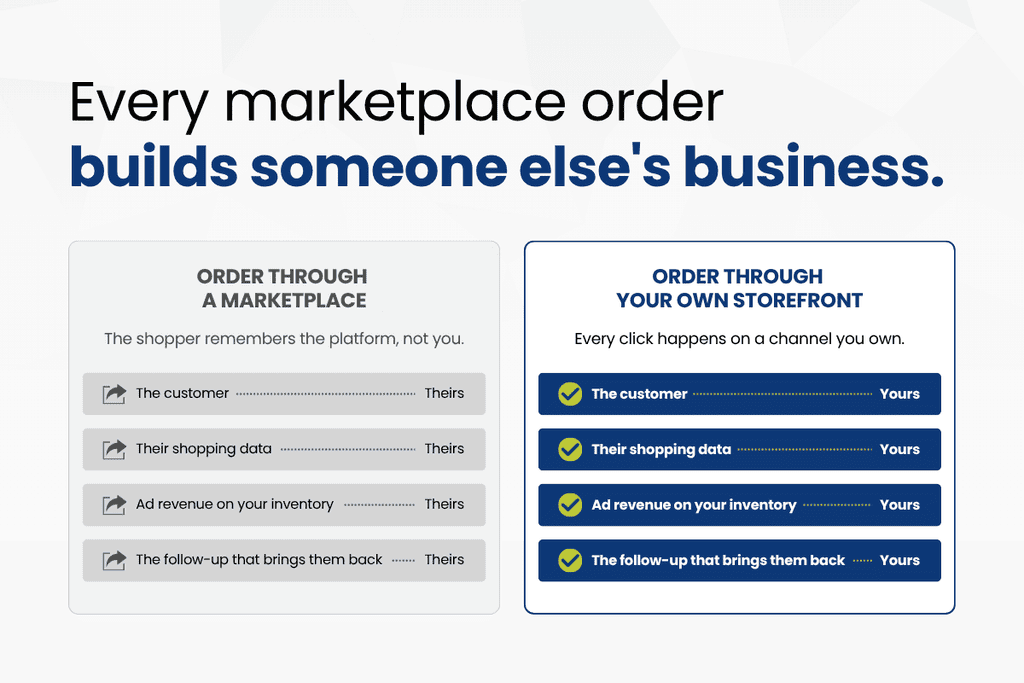
Every order that runs through it belongs to the platform, along with the interface, the communication, the customer data, and the ad revenue the platform sells against your inventory.
The end result is that the shopper remembers ordering from Instacart, not from you.
The cost isn’t only the commission on every order, though that alone eats into the already-thin grocery margins.
The deeper cost is the intelligence you never see.
You don’t learn what that shopper browsed, what they skipped, or when they’re likely to come back, which means you can’t send them a relevant follow-up and can’t tell when they’ve quietly started spending elsewhere.
By the time a defection shows up in your aggregate sales, the wallet share is gone and hard to win back.
Owning your storefront reverses that.
Every click, search, and clipped coupon happens on your site or app, which means the shopper picture, the ad inventory, and the follow-up all belong to you. Marketplaces can still send new shoppers your way, but the goal is to move them onto channels you own as quickly as possible, so the relationship, and everything you learn from it, is yours to build on.
2. Personalize Offers and Recommendations Around What Each Shopper Buys
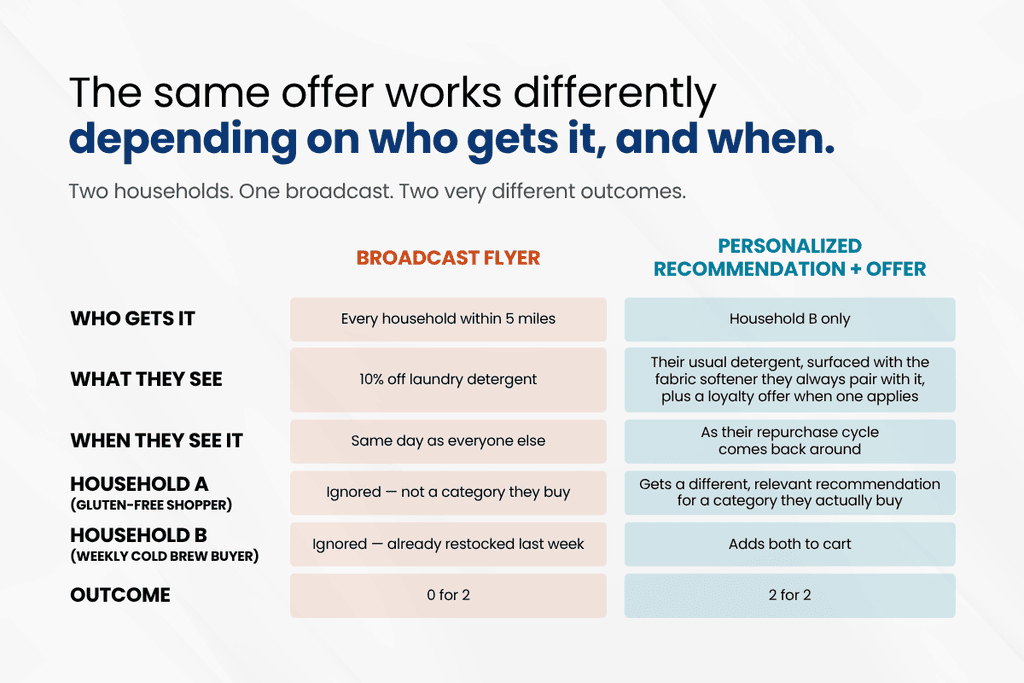
A broadcast promotion treats the household that buys gluten-free everything the same as the one that goes through a case of soda a week. Both get the same discount on the same items, and both mostly ignore it.
Personalized engagement starts from what a shopper has already told you through their purchases, their searches, and the coupons they clip.
The household that buys the same laundry detergent every few weeks doesn’t need ten percent off to come back for it. They need it surfaced again as their supply runs low, ideally alongside the fabric softener they reach for in the same trip. That’s a product recommendation, not a discount.
Which is the difference between reminding someone of what they already want and hoping a markdown catches their eye.
When a discount does make sense, that same purchase history is what makes it work. Rather than a blanket promotion, a personalized offer from your loyalty program gets surfaced on the detergent they actually buy, timed to when they would normally restock. And when their usual product is out of stock, that same signal can suggest a smart substitution, so a gap on the shelf doesn’t turn into an abandoned cart.
Timing is the other half of the equation. You don’t need to guess the exact day the bottle runs dry, just the rhythm of how often they buy. Reach them as that cycle comes back around and the detergent goes in the cart. Reach them too early or too late, and the message either gets ignored or arrives after they’ve already restocked somewhere else.
3. Reach Shoppers Across Email, Text, and App
Your shoppers aren’t all reachable in the same way, and treating them as if they are is why your marketing efforts fail to move anyone.
Consider three regulars in the same store.
One reads every email you send and clips coupons directly from it, another never opens an email but answers a text within seconds, and a third does everything inside your app and ignores the other two channels entirely.
All three are loyal, and all three are reachable, but only if the message goes through the channel they actually use.
That’s what multichannel engagement really is. Not being everywhere, but being in the one place each shopper already pays attention, and using what they’ve clicked, opened, and ignored to know which place that is.
When the offer happens on the channel a shopper responds to, they act on it. When the same offer goes out on every channel at once, it wastes the ones they ignore and burns credibility on the ones they don’t.
The payoff is that the shoppers who engage across more than one of your channels tend to be your highest-value segment. Earning their attention on the right channel doesn’t just win the current transaction, it keeps you on the short list every time they plan a shop.
4. Make Loyalty Personal Enough to Be Worth Keeping
If you swapped the logo on most grocery loyalty programs, most shoppers wouldn’t even notice the difference.
That’s because they all follow the same “spend a dollar, earn a point” formula that treats every shopper as if they buy the same things, in the same amounts, at the same time.
Instead of a flat points-per-dollar rate, try expanding and personalizing your loyalty program around what you shoppers actually want and need:
- A shopper who buys organic produce every week could earn double points in that department.
- A household that goes through a specific coffee brand gets early access to the next promotion on it.
- A shopper who hasn’t been in for a month gets an offer built from what they used to buy, not a generic “we miss you” coupon.
Each reward is a small signal that the store knows this shopper, which is exactly what a generic points program can’t send.
Personalized loyalty is worth investing in because keeping a shopper costs far less than winning a new one. Every regular who drifts to a competitor is a shopper you now have to replace with several harder-won newcomers, and personalization is what keeps them from drifting in the first place.
5. Turn Your Shopper Data Into a Second Revenue Stream
There’s a way regional grocers can make money from their online store beyond what shoppers spend in it, and most aren’t using it yet.
It’s called Retail Media.
The brands whose products sit on your shelves, from Coca-Cola to Kellogg’s to General Mills, spend enormous amounts of money each year trying to reach the shoppers who actually buy those products.
Your store’s website and app are one of the few places where those shoppers show up already thinking about groceries, which means the space inside them is valuable advertising real estate.
With Retail Media, you sell that space to the brands who want them, and they pay to reach the shoppers you’ve already brought to your site.
National chains figured this out years ago and built entire ad-sales businesses on top of their shopper data.
A regional grocer’s audience is often even more valuable to those brands, because your shoppers are loyal, local, and buy in patterns a national chain can’t replicate.
Retail media is still emerging at the regional level because most regional grocers don’t yet own the two things it takes to sell ad space, a storefront under their own brand and the shopper data behind it.
Bring Your Digital Customer Engagement Together With DXPro
Every regional grocer already has the shopper data the strategies above depend on. The trouble is that it’s split across four or five systems that don’t talk to each other.
DXPro is the digital experience platform that brings your commerce, engagement, and fulfillment into a single system, so every click, coupon, and order connects to one shopper record instead of four. Alongside that unification, our embedded intelligence reads that record in real time and uses it to send offers, promotions, and messages through whichever channel each shopper actually responds to.
When your systems share one record of the shopper data everything stays inside your business, every interaction informs the next, and your team stops rebuilding the picture of your shopper from scratch every time they send a campaign.
Compete on Knowing Your Shopper, Not Undercutting Big-Box Retailers
You can’t win a price war against Walmart or Amazon, but you can win the shopper who wants to be known by the store they buy from. You already have what it takes, from their name to their habits to the rhythm of their weekly cart.
Every offer a shopper responds to tells you something new about them, which sharpens the next offer you send. Do that multiple times over a year, and you don’t just have a shopper, you have a household you can predict, and predictability is what grows Customer Lifetime Value.
Book a walkthrough of DXPro and see how the shopper data you already have turns into repeat customers.
