


 Platform Overview
 Unified Intelligence
 Customer Engagement
 Commerce and Fulfillment
 Retail Media Network
 About Us
 Come Work with Us
 Newsroom
 Events
 Insights
 Blog
Blog
 Digital Grocer Podcast
5 Online Grocery Shopping Habits Grocers Can’t Afford to Ignore in 2026
This article was originally published on October 29, 2020. It was updated on June 15, 2026.
There’s a number that should recalibrate how every regional grocer thinks about their digital investment.
According to Mercatus research, households that buy groceries online and in-store spend an average of $5,300 on groceries annually. Households that only buy in-store spend $3,500.
That’s not a marginal difference. It’s a $1,800 gap driven entirely by whether a shopper has integrated online grocery into how they manage their week.
The online grocery market is growing for a reason.
Yes, an increasing number of shoppers are finding it more convenient than walking into a store. But it’s always been more convenient to order online.
What’s changed is the frequent online engagement and increased grocery spending reinforcing each other.
The grocers and retailers who understand this relationship are building the kind of customer loyalty that compounds over time.
Here are the five online grocery shopping habits reshaping the industry in 2026, and what each one demands from the grocers competing for these shoppers.
1. Online Grocery Shoppers Hunt Value Before Every Trip
The inflation cycle of the early 2020s changed grocery shopping behavior in ways that outlasted the inflation itself.
Progressive Grocer’s 2026 Consumer Expenditures Study found that three in four shoppers have materially changed how they buy groceries in response to rising food prices. This includes trading down to private labels, cutting unplanned purchases, comparing deals across banners before committing to a trip.
Food prices have since moderated. The habit hasn’t.
What started as a defensive consumer behavior has become standard operating procedure for a large share of the online grocery industry’s most active shoppers. They’re running a value calculation before every trip, and they’re running it across multiple online grocery retailers simultaneously.
Why More Promotions Compound the Problem
The instinct when facing price-sensitive shoppers is to respond with more discounts. Broader promotions, heavier digital circulars, more aggressive feature pricing.
In practice, that instinct is counterproductive.
When grocery shoppers learn that waiting produces better prices, they stop making purchases out of habit, and instead, hold off until a sale appears.
The result is margin cut on products that didn’t need discounting, and customers who are harder to predict and less profitable to serve.
What Price and Value Actually Means to Grocery Shoppers
While the continued growth of mass retailers suggests that price and value highly influence what shoppers like most about their primary store. That doesn’t necessarily mean the lowest sticker price always wins out.
Increasingly, it’s about creating the feeling that a customer’s money goes further on the things they actually buy.
Online grocery services that deliver relevant offers on the right items at the right time earn the trip. Those that send the same circular to everyone remain one stop among five.
2. No Single Online Grocery Retailer Has Everything, So Shoppers Build a Rotation
If your customers are shopping multiple banners every week, the temptation is to treat it as a customer loyalty problem.
However, most of your customers don’t want to shop around like this. They just can’t find all that they’re looking for from one retailer.
No single online grocery experience in 2026 reliably delivers on assortment, price, fresh produce, and values simultaneously. So, shoppers fill each gap with whoever covers it best:
- Walmart for staples and household goods.
- A specialty grocer for organic products and items tied to specific dietary preferences.
- A discount banner for bulk.
And somewhere in that rotation, your store.
Consumer research confirms this pattern across income levels and demographics. This isn’t just generational behavior or a signal that shoppers are uncommitted. It’s what happens when no single grocery store gives consumers everything they need in one place.
That reframe matters for how grocery retailers respond to it.
The question isn’t how to get into the rotation. Most regional grocers are already there. The question is how to become the banner that earns the large primary shop and makes the other four feel optional.
Grocers who understand what’s driving shoppers to split their grocery budgets, and close those specific gaps, stop sharing baskets with four competitors and start owning it completely.
3. Customer Loyalty Now Runs Through the App
Loyalty program participation has hit an all-time high.
Progressive Grocer’s 2026 State of the Industry Survey found 84% of grocery retailers now rate loyalty programs as their top consumer engagement strategy, a 12-point jump from the prior year.
That shift reflects where the primary weekly shop is actually being decided.
Nearly two-thirds of grocery shoppers are actively enrolled in and using a loyalty program, and the features driving that engagement are personalized coupons, rewards visibility, and digital grocery lists. Progressive Grocer also found that 57% of shoppers say retailer apps for personalized discounts and recommendations are the most valuable digital feature available to them. This is a 10-point increase year over year.
The Cost of the Engagement Gap
Those numbers tell a specific story.
Shoppers are actively choosing which online grocery retailers they want a deeper relationship with, and they’re signaling that choice through the time and attention they invest in these tools.
A shopper who clips digital coupons before leaving the house has pre-committed to your store for that trip. A shopper building their weekly list inside your app has done the cognitive work of that purchase inside your ecosystem before a competitor enters the picture.
Grocers without capable loyalty and app infrastructure are absent from the habit loop that determines which banner captures the primary weekly shop.
Mercatus research shows that shoppers who engage with a grocer’s digital platform four or more times a month take significantly more trips and spend considerably more per year than those who engage once a month or less.
That gap represents the difference between a customer who’s in your rotation and one whose week is organized around you.
4. Personalization Has Become the Price of Admission
Personalization has become what grocery shoppers expect before they give a banner sustained attention. It’s no longer a feature customers notice when it works well. It’s now a friction they feel when it’s absent.
Progressive Grocer’s 2026 Consumer Expenditures Study found that three-quarters of consumers see themselves as health-conscious, significantly up from the prior year. More than 70% use AI tools to find deals before they shop.
Years of experience with Amazon, Netflix, and Spotify have trained most consumers to expect that a platform understands their preferences before they state them.
When a grocery app falls short of that standard, shoppers don’t complain to anyone. They open a different app.
How Shoppers Find Products in the Online Grocery Industry Today
Shoppers arrive at your digital storefront with preferences already formed through social feeds, peer recommendations, and AI-assisted deal-finding. Search that returns generic results and apps that don’t learn from browsing history push customers toward competitors who make the process easier.
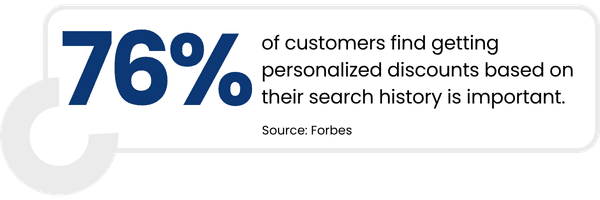
Incisiv/Grocery Doppio research found that 89% of shoppers want personalized experiences while only 4% of grocery retailers deliver them at scale. That isn’t just a performance gap. It’s a chasm that well-resourced online grocery retailers are actively closing.
Every quarter your digital experience stays static is a quarter that space narrows in favor of your competitor.
5. Delivery Services Are Growing — But Grocery Retailers Can’t Win on Delivery Alone
Online grocery sales driven by delivery services have grown significantly, and grocery shoppers now expect delivery as a standard option.
Progressive Grocer’s 2026 State of the Industry Survey found that 77% of grocery retailers currently offer third-party delivery, a 13-point jump from the prior year, with 87% either offering it or planning to add it.
That growth tells you something important: delivery is becoming the expectation across the online grocery market. But knowing that isn’t the hard part for grocers. What’s difficult is structuring delivery so it doesn’t cost you margin on every order and/or hand your customer data to the third-party marketplace running it.
Third-party delivery services solve a distribution problem while creating a different one. Grocery retailers operating through delivery marketplaces inherit those platforms’ fee structures, substitution logic, and customer communication — and hand over the first-party data that makes personalization possible.
The customers completing those transactions belong, functionally, to the platform rather than the store. And the data that’s collected from your sales is used to increase sales across the entire marketplace, including your competitors.
Why In-store Shopping Still Gets the Last Word
FMI’s 2026 U.S. Grocery Shopper Trends report found that 54% of grocery shoppers always shop in-store at their primary store. In-store shoppers say control over fresh produce selection, confidence in what they’re buying, and the efficiency of a familiar store are the reasons the physical trip remains non-negotiable for them.
The online grocery industry conversation tends to treat in-store shopping as declining. The more accurate read is that it’s being earned differently.
The shopper who engages with your app several times a week, clips personalized coupons before leaving the house, and receives a relevant push notification on the way out arrives in-store with intent and a list. The shopper with no digital relationship with your banner shops on the convenience of proximity, a signal that a free delivery offer from a competitor offer can easily erode.
What These Five Habits Tell Us About the Online Grocery Market
Taken individually, each habit in this article describes a challenge.
Shoppers hunt for value before every trip. Grocery budgets are split across multiple banners. Customer loyalty runs through an app. Personalization is expected as a baseline. In-store visits that are earned digitally before a shopper even leaves the house.
Taken together, they describe the same underlying shift: grocery shoppers have more options, more information, and more leverage than they’ve ever had, and they’re using all of it every week.
These aren’t five separate problems requiring five separate solutions. These are five expressions of how the online grocery industry has changed the relationship between shoppers and the stores they choose.
What Regional Grocers Need to Compete
In other words, the five habits above don’t require a complete overhaul of how regional grocers operate.
They require the right infrastructure to respond to them:
- Closing the gaps that send shoppers to a competitor’s delivery services.
- Building the loyalty infrastructure that makes your app the place households organize their week.
- Using first-party data to deliver personalized offers that make your grocery store more relevant than the others in the rotation.
None of that requires matching Walmart’s scale. It requires knowing your customers better than the competition and having the tools to act on that in the moment it matters most.
DXPro from Mercatus connects commerce, fulfillment, and customer data into the unified system that modern online grocery shopping habits demand.
Every week these habits go unaddressed is a week your highest-value shoppers are deciding someone else deserves their primary business. Talk to Mercatus today about what DXPro can do for yours.
