


 Platform Overview
 Unified Intelligence
 Customer Engagement
 Commerce and Fulfillment
 Retail Media Network
 About Us
 Come Work with Us
 Newsroom
 Events
 Insights
 Blog
Blog
 Digital Grocer Podcast


Are You Giving Away Your Most Valuable Business Asset Without Knowing It?
Shoppers are buying smaller baskets and making more deliberate trips.
According to industry analysis from Supermarket News, Circana data shows food unit sales growth in negative territory so far in 2026, while Placer.ai data shows consumers visiting grocery stores more often but spending less time inside.
Online grocery, meanwhile, continues to post double-digit sales growth across both food and nonfood categories.
What does it all mean?
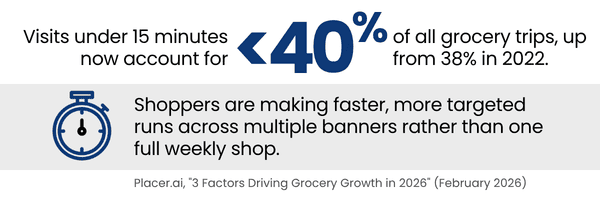
The people purchasing groceries for their households this week aren’t just spending less. They’re running a continuous value calculation across multiple banners and fulfillment options.
Digital is the one channel gaining ground in an environment where shoppers are spending less everywhere else because digital makes it easier for shoppers to make the behavioral shift we’ve outlined above.
How you respond to that shift will determine whether you build deeper customer relationships and more lifetime value from the data your shoppers generate, or whether someone else does it for you.
What Inflation Actually Did to Grocery Shoppers
The inflation cycle of the early 2020s has changed what consumers buy and how they decide.
In addition to the data Supermarket News has recently collected, Progressive Grocer’s 2026 Consumer Expenditures Study found that three in four shoppers have materially changed how they buy groceries in response to rising food prices

This has led to trading down to private labels, cutting unplanned purchases, comparing deals across banners before committing to a trip.
Even as food prices have moderated, the behavior hasn’t. Gas prices and rising costs elsewhere have played a role in diminished household budgets, but the larger truth is that deliberate shopping has simply become habit.
What started as a defensive response is now standard operating procedure. Today’s most active grocery shoppers contrast and compare all options available to them.
They’re not waiting for economic conditions to improve before going back to buying on autopilot. There is no autopilot anymore.
Deliberate Shoppers Are Deliberate Online, Too
Online grocery gives value-conscious shoppers the tools to do their value calculations efficiently through price comparisons, saved lists, promotional visibility, and flexible fulfillment.
That has transformed a channel that was once a convenience play into an operational one. It’s also made it the primary tool for grocers to deepen their customer relationships.
Online grocery’s double-digit growth alongside declining unit sales elsewhere isn’t incidental. It’s the result of deliberate shoppers using digital tools to get what they want.
The irony is that these shifting shoppers are generating richer behavioral data than the passive shoppers they used to be. Every comparison made, every promotion evaluated, every channel switched reveals something about what a customer actually values.
That data has never been more valuable, and neither has the ability to act on it.
Retaining modern consumers requires knowing what they’re doing, what they’re responding to, and when they’re starting to drift.
Why Third-party Marketplaces Feel Like the Logical Response
Who has that knowledge?
Based on what we’ve seen from Brick Meets Click’s eGrocery sales data in the past, it’s safe to assume that mass retailers are benefitting the most from increased digital shopping.
We all know the capabilities of Walmart and Amazon. Those retailers are able to offer lower product prices, faster delivery, and free fulfillment.
But that’s not all.
They’ve spent years building digital infrastructure — recommendation engines, fulfillment networks, behavioral data accumulated across hundreds of millions of transactions — that makes every customer interaction smarter than the last. Mass retailers have used lower prices to bring more shoppers through their doors, and then connected data to engagement so that their customer relationships become a compounding asset.
That’s a hard thing to watch from the outside.
The appeal of Instacart, DoorDash, and other third-party marketplaces is obvious in this context. They offer instant digital reach, an existing shopper base already comfortable buying groceries on an app, and no capital-intensive infrastructure rebuild to access it.
For a grocer trying to compete for the same digitally-active shoppers that mass retailers are attracting, the marketplace looks like an easy solution.
But there is no such thing as a free lunch.
What You’re Actually Handing Over When You Join a Marketplace
When a transaction happens on Instacart or DoorDash, the grocer fulfills the order. But that’s not all that’s going on.
The browsing session that preceded it, the items the shopper viewed before choosing, the substitution preferences they’ve built up over time, the promotional patterns that reveal what actually moves them combines for a behavioral record that belongs to the platform.
This is how third-party marketplaces generate value.
The platform aggregates shopper behavior across every retailer on the network, uses that data to improve its targeting and recommendation capabilities, and sells access to those capabilities back to CPG brands.
The grocer provides the inventory and the customer. The marketplace reaps the reward.
The Competitor Problem Hidden in the Data
When a shopper’s purchase history from your store feeds into a marketplace’s data model, it doesn’t stay compartmentalized. It joins the pool that sharpens that platform’s ability to serve every retailer on the network, including the competing grocery chains listed three rows above you in the app.
The basket your customer built this week makes the algorithm smarter next week, and that smarter algorithm will use what it learned to serve better recommendations the next time they open the app, regardless of which banner captures the transaction.
Your data is actively improving the marketplace experience for your competitors.
What You Lose the Ability to Do
Without customer data, a grocer can’t identify which shoppers are drifting before they actually leave.
You can’t send a retention offer to the household whose basket composition just shifted toward a competitor. And you can’t recognize that a high-value customer hasn’t placed an order in six weeks and respond while there’s still time.
Every one of those interventions requires knowing what’s happening inside your customer relationships.
The Asset Already Sitting in Your Owned Channel
Every regional grocer running an owned digital channel is already generating first-party data.
There’s information available for every completed order, every item browsed and not purchased, every list built in the app, every promotion that triggered a click, and every one that didn’t.
The problem is that most of it is either going uncollected or captured in fragments that never connect into a picture of how individual customers actually shop.
When first-party data is consolidated and connected, it changes what’s possible. Instead of missing out on the high-value lapsing shopper, a grocer can see that a customer’s purchase frequency has declined over the past six weeks and trigger an automated retention strategy proven to get results.
Turning Owned Data into Customer Engagement
The transformation described above isn’t a technological aspiration. DXPro exists right now to give regional grocers the infrastructure to connect customer data to customer action.
Its embedded customer data platform captures every on-platform interaction and builds unified profiles that show how individual customers actually shop. That includes behavioral patterns across visits, fulfillment methods, and time.
Those profiles feed directly into engagement programs built around specific outcomes: win-back offers for shoppers whose purchase frequency is declining, replenishment reminders timed to a high-value customer’s actual shopping cycle, first-order incentives for store-only regulars who’ve never placed a digital order.
The Cycle That Compounds Over Time
What makes DXPro so valuable to retailers is how it compounds its value over time.
Every engagement with a customer generates new behavioral data. Every piece of new data makes the next engagement more accurate. The shopper who responds to a win-back offer reveals what pricing actually moves them. The store-only regular placing their first online order begins generating digital behavioral data the grocer never had before.
What we’re describing here is a system like Walmart’s or Amazon’s where the customer relationship gets smarter with every interaction. This is how you compete with the mass retailers benefiting most from online grocery’s growth.
Own the Data. Build the Relationship
The data your customers are generating right now has tremendous value.
Walmart knows it. Amazon knows it. Instacart and Door Dash know it, too.
The behavioral data generated by grocery transactions doesn’t just make those platforms better at serving shoppers. It makes them attractive to the CPG brands that want to reach those shoppers.
First-party shopper data, at scale, is an asset that pays twice: once through better engagement, and again as a revenue channel in its own right. Right now, regional grocers are generating that asset and handing it to someone else to monetize.
That’s the bigger picture of what’s at stake and what becomes possible when you own your customer data.
Mercatus works with regional grocers to build a customer engagement infrastructure through DXPro.
Whether the starting point is fragmented data, an existing platform with limited engagement capabilities, or a digital channel generating behavioral signals that nobody’s acting on, the path to stronger customer relationships that result in more sales that deliver higher profits starts with a conversation about what’s possible.
Contact our sales team to see what DXPro can do for your grocery business.
